Income & Wealth Building
How Compound Interest Can Make You Rich
Compound interest is often called the eighth wonder of the world. Here is how it actually works, with real numbers showing how it can turn modest savings into significant wealth.

Compound interest is often described as one of the most powerful forces in personal finance, and the actual numbers behind it explain why. Unlike simple interest, which only pays you on your original deposit, compound interest pays you interest on your interest, creating growth that accelerates the longer your money stays invested.
Here is how compound interest actually works, with real examples showing how it can turn modest, consistent savings into significant long-term wealth.
Simple Interest vs Compound Interest
If you deposit $1,000 in an account earning 3 percent simple interest, you earn a flat $30 every year, since simple interest is only calculated on your original principal. Compound interest, by contrast, is calculated on your principal plus all previously accumulated interest, meaning your growth accelerates over time rather than staying flat.
A Real Example of Compounding in Action
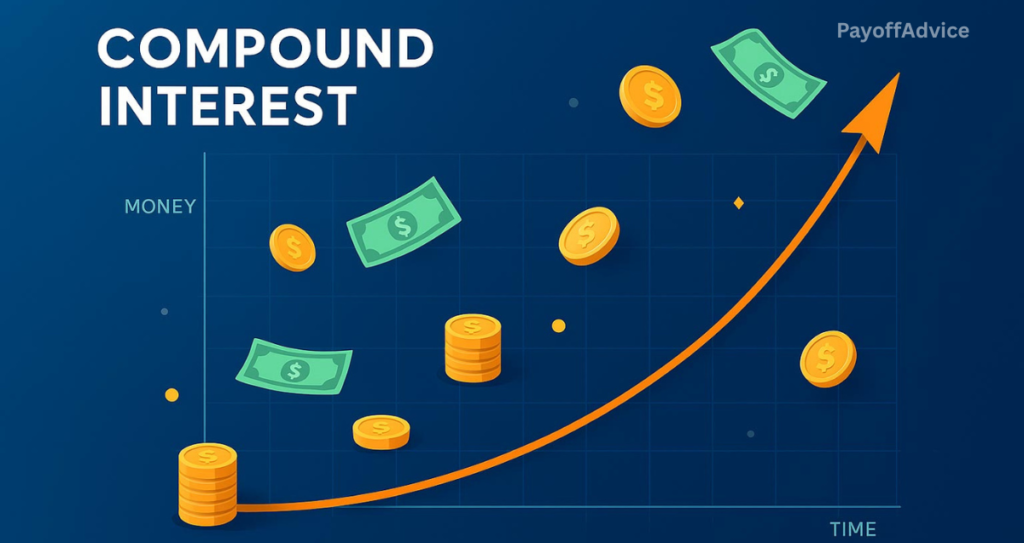
Imagine you invest $100 at a 6 percent annual return. After year one, you have $106. After year two, you earn 6 percent not just on your original $100, but on the full $106, giving you just over $112. This might look modest at first, but the effect compounds dramatically over longer periods, since every year’s interest becomes part of the base that earns interest the following year.
Why Time Matters More Than the Amount You Start With
According to financial modeling from CompoundLadder, someone contributing $1,000 a month at an 8 percent return reaches $1 million in about 22 years, with 69 percent of that final total coming from compound growth rather than the actual contributions made. This illustrates a core truth about compounding: the money you contribute matters, but the time it has to grow often matters even more.
The Rule of 72: A Quick Mental Shortcut
You can estimate how long it takes your money to double by dividing 72 by your annual rate of return. At a 6 percent return, your money doubles roughly every 12 years. At a 10 percent return, closer to the long-term stock market average discussed in our guide on index funds explained for beginners, your money doubles roughly every 7.2 years.
How Regular Contributions Supercharge Compounding
Compounding is powerful even with a single lump sum, but it becomes dramatically stronger when combined with regular contributions. According to NerdWallet’s calculator modeling, a $10,000 deposit earning 4 percent annually grows to about $14,918 in interest alone over 10 years. Adding just $100 a month in contributions to that same scenario grows the total to nearly $29,648, with $7,648 of that coming from interest, nearly doubling the interest earned compared to the lump sum alone.
Why Starting Early Beats Contributing More Later
Because compounding accelerates over time, starting even a few years earlier can outweigh contributing significantly more money later in life. Someone who starts investing in their early twenties, even with smaller contributions, often ends up with more wealth by retirement than someone who starts a decade later with larger contributions, purely because of the extra years of compounding. Our guide on investing with your first paycheck covers how to take advantage of this timing benefit from the very start of your career.
Compound Interest Works on Debt Too, Against You
The same mathematical force that builds wealth in savings and investments works in reverse against you with high-interest debt like credit cards. Carrying a balance means you are paying compound interest on your debt, which can grow just as aggressively as compound growth on investments, making high-interest debt one of the most urgent things to eliminate before focusing heavily on other financial goals.
Realistic Expectations for Your Own Compounding Timeline
Compound interest calculators can show impressive theoretical outcomes, but real returns vary year to year, and no investment guarantees a fixed annual return the way these examples assume for simplicity. Inflation also erodes the real purchasing power of your compounded wealth over time, meaning a projected $1 million in 22 years might be worth meaningfully less in today’s purchasing power by the time you reach it.
How to Put Compounding to Work Starting Today
The most effective way to harness compound interest is to start now, automate consistent contributions, and avoid interrupting the compounding process by cashing out early. Even small, regular amounts benefit meaningfully from decades of uninterrupted growth, which is why consistency generally matters more than trying to perfectly optimize your rate of return.
Final Thoughts
Compound interest rewards patience and consistency far more than large lump sums or perfect timing. Understanding the mechanics, interest earning interest on top of interest, helps explain why starting early, staying invested, and avoiding high-interest debt are consistently among the most powerful wealth-building habits available to anyone, regardless of how much they start with.
Frequently Asked Questions
1. What is the difference between simple and compound interest?
Simple interest is calculated only on your original principal, while compound interest is calculated on your principal plus all previously earned interest.
2. How long does it take to reach $1 million through compounding?
At $1,000 a month and an 8 percent return, it takes roughly 22 years, with about 69 percent of the final total coming from compound growth rather than contributions.
3. What is the Rule of 72?
It is a quick way to estimate how long your money takes to double by dividing 72 by your annual rate of return.
4. Does starting early really matter that much?
Yes, starting even a few years earlier can outweigh contributing significantly more money later, since compounding accelerates the longer money stays invested.
5. Can compound interest work against me?
Yes, carrying high-interest debt like credit card balances means compound interest works against you, growing your debt in the same way it grows investments.
6. Do regular contributions matter if I already have a lump sum?
Yes, adding regular contributions on top of a lump sum significantly increases total interest earned compared to leaving a lump sum untouched alone.
7. Is compound interest guaranteed on investments?
No, investment returns vary year to year and are never guaranteed, unlike a fixed-rate account where the interest rate is set in advance.
8. Does inflation affect compound growth?
Yes, inflation erodes the real purchasing power of your compounded wealth over time, so a projected future dollar amount is worth less in today’s terms.
9. What accounts commonly use compound interest?
Savings accounts, CDs, and investment accounts all typically compound returns, though the term compound interest specifically applies to accounts with a guaranteed rate.
10. What is the fastest way to benefit from compounding?
Starting as early as possible and automating consistent contributions, rather than trying to perfectly time your investments, is generally the most effective approach.