How To Invest
How to Start Investing in 2026: A Step-by-Step Guide for Beginners

If you’re wondering how to start investing in 2026, the timing is more interesting than it might first appear. Gallup’s April 2026 survey found that just 58% of U.S. adults now own stock, either directly or through a fund or retirement account, down from 62% in 2025. That’s the first meaningful pullback in stock ownership since 2016, driven by market volatility and economic uncertainty. Yet the mechanics of investing have never been more accessible: brokerages with no minimums, fractional shares, zero-commission trades, and index funds charging a fraction of a percent in fees. This guide walks through the concrete steps to start investing in 2026, from shoring up your finances to choosing accounts and funds that fit your goals.
Why 2026 Is a Different Starting Point
Retirement savers, meanwhile, are moving in the opposite direction of stock owners generally. Fidelity’s Q1 2026 retirement analysis, based on 25.6 million participants, found the average 401(k) balance fell 4% quarter-over-quarter to $141,000 amid market swings, but was still up 11% year-over-year. More notably, the average combined 401(k) and 403(b) savings rate hit a record 14.4% in the first quarter, meaning the people already investing kept contributing through the volatility rather than pulling back. That combination, fewer new investors but steadier contributions from existing ones, is a useful signal: starting now with a modest, automatic contribution matters more than waiting for a calmer market that may not arrive on schedule.
Step 1: Get Your Foundation in Place First
Before opening a brokerage account, make sure your financial foundation can absorb a downturn without forcing you to sell. That starts with knowing how much you should have in an emergency fund, since a cash cushion is what keeps a market dip from becoming a personal financial crisis. It’s also worth working through whether you should pay off debt or invest first, particularly if you’re carrying credit card balances at 20% APR or higher — that math rarely favors investing over payoff. Once high-interest debt is under control and you have a few months of expenses set aside, you’re in a much stronger position to ride out normal market volatility instead of reacting to it.
Step 2: Choose the Right Account Type
Where you invest matters almost as much as what you invest in, because of the tax treatment. A 401(k) is employer-sponsored and often comes with a matching contribution — free money you should generally capture in full before investing elsewhere. For 2026, the IRS raised the employee 401(k) contribution limit to $24,500, with an $8,000 catch-up for savers 50 and older (and $11,250 for those 60-63). An IRA, opened independently of an employer, caps out lower at $7,500 for 2026 but typically offers a broader menu of investments than a workplace plan. A taxable brokerage account has no contribution limit or withdrawal restrictions at all, making it useful once you’ve maxed out tax-advantaged space or want access to the money before retirement age. See the full IRS announcement on 2026 contribution limits for the complete breakdown.
Step 3: Build Around Low-Cost Index Funds
Once you’ve picked an account, resist the urge to hand-pick individual stocks right away. Index funds, which hold every company in a market benchmark like the S&P 500, charge an average expense ratio of just 0.09%, compared with 0.56% for actively managed funds, according to industry data. The broader fund industry average sits around 0.17%, and some providers now offer index funds with expense ratios as low as 0.03% — or even 0%. That gap compounds: a 0.5 percentage point difference in fees can cost tens of thousands of dollars over a multi-decade investing horizon. For a first fund, look for:
- Broad market exposure (total U.S. or total world stock index) rather than a single sector or company
- An expense ratio under 0.10%
- No investment minimum, or one you can comfortably meet
- Availability inside your 401(k), IRA, or brokerage without extra transaction fees
Step 4: Automate Contributions and Use Dollar-Cost Averaging
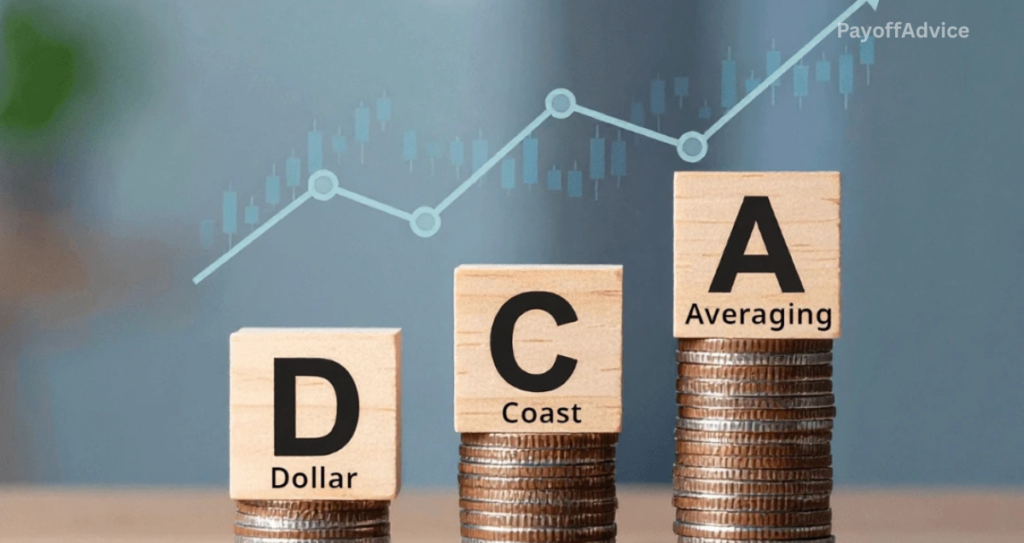
Once you’ve chosen an account and a fund, automate it. Set up a recurring transfer that lines up with payday so investing happens before you have a chance to spend the money elsewhere. This approach, known as dollar-cost averaging, means you buy more shares when prices are low and fewer when prices are high, smoothing out your average cost over time instead of trying to guess the market’s next move. If you’re still building your emergency fund in parallel, keep that cash in a high-yield savings account — top accounts were paying up to 4.50% APY in July 2026, compared with a 0.38% national average, so idle cash doesn’t have to sit idle.
Step 5: Set Realistic Expectations
Finally, calibrate your expectations. The S&P 500 has returned roughly 13-15% annually over the past decade, a stretch of unusually strong performance well above its 10.3% long-run average since 1957. Planning around 8-10% average annual returns, rather than assuming the last ten years repeat, will keep you from being blindsided by a flatter stretch ahead. The most common mistakes beginners make aren’t really about fund selection — they’re behavioral: waiting for a “better” time to start, paying fees they never noticed, panic-selling during a downturn, or skipping the emergency fund step and being forced to cash out investments at the worst possible moment. Avoid those four things, automate a contribution you can sustain, and the account balance you check in ten years will look very different from the one you’d have if you kept waiting for a certainty that markets rarely provide.
Frequently Asked Questions
How much money do I need to start investing in 2026?
Many brokerages now have no account minimums, and fractional shares let you buy a slice of an ETF or stock for as little as $1-$5. The bigger question isn’t the entry fee — it’s having 3-6 months of expenses saved first so you’re not forced to sell investments during a downturn.
Should I pay off debt before I start investing?
It depends on the interest rate. High-interest debt like credit cards (often 20%+ APR) usually outpaces realistic market returns, so paying it down first typically wins. Lower-rate debt, like a 4-6% mortgage, can often be paid on schedule while you invest in parallel.
What’s the difference between a 401(k) and an IRA?
A 401(k) is employer-sponsored, often includes a company match, and has a higher 2026 contribution limit of $24,500. An IRA is opened independently, caps out at $7,500 in 2026, but usually offers a wider range of investment choices.
Are index funds better than individual stocks for beginners?
For most new investors, yes. Index funds spread your money across hundreds or thousands of companies for an average expense ratio around 0.09%, reducing the risk that any single company’s bad quarter wipes out your progress.
What return can I realistically expect from the stock market?
The S&P 500 has returned roughly 13-15% annually over the past decade, well above its 10.3% average since 1957. Financial planners generally recommend modeling future returns closer to that long-run 8-10% range rather than assuming recent years repeat.
How much of my paycheck should I invest?
A common starting benchmark is 10-15% of gross income, which lines up with the record 14.4% average 401(k) savings rate reported by Fidelity in Q1 2026. Start lower if needed and increase the percentage with each raise.
What’s dollar-cost averaging?
It’s investing a fixed amount on a regular schedule, like every paycheck, regardless of whether prices are up or down. Over time this smooths out your average purchase price and removes the guesswork of trying to time the market.
Should I use a robo-advisor or pick my own funds?
Robo-advisors automatically build and rebalance a diversified portfolio for a small annual fee, which suits investors who want a hands-off approach. Picking your own low-cost index funds works well if you’re comfortable rebalancing once or twice a year yourself.
What are the biggest mistakes new investors make?
The most common are waiting for the “right time” to start, paying high fees without realizing it, panic-selling during downturns, and skipping an emergency fund so a market drop forces an untimely withdrawal.
Is it too late to start investing in 2026?
No. Even with stock ownership dipping to 58% this year, time in the market matters more than timing your entry. A 25-year-old starting now with automated monthly contributions still has decades of compounding ahead.