Debt Management & Credit
10 Proven Ways to Pay Off Credit Card Debt Fast in 2026
Pay off credit card debt fast in 2026 with 10 proven strategies backed by real Federal Reserve interest-rate data and expert-tested tactics.


If you’re trying to pay off credit card debt fast in 2026, you’re up against the highest interest rates in a generation. Total U.S. credit card debt hit $1.252 trillion in the first quarter of 2026, and the average American now carries $6,715 in credit card balances, up from $6,580 a year earlier. With average APRs sitting at 22.15% on accounts that carry a balance, every month you wait costs real money. The good news: a handful of proven, repeatable tactics can cut years off your payoff timeline and save you thousands in interest. Here’s what the data says actually works.
Why Credit Card Debt Is Harder to Escape in 2026
Interest rates are the biggest obstacle. The Federal Reserve’s G.19 consumer credit report shows average APRs on interest-accruing accounts climbed to 22.15% in the second quarter of 2026, up from 21.52% the quarter before, and some issuers charge as much as 34.6% depending on your credit profile. At a 22% APR, a $5,000 balance paid only at the 2% minimum takes roughly nine years and seven months to clear, and you’ll hand over about $6,520 in interest — more than the original balance. Delinquency isn’t rare either: the 30-day past-due rate stood at 8.61% in the first quarter of 2026, according to the New York Fed’s household debt data. None of this means you’re stuck. It means minimum payments alone are a losing strategy, and the ten methods below are what separate people who stay in debt for a decade from people who pay off credit card debt fast.

10 Proven Ways to Pay Off Credit Card Debt Fast
- Pick a payoff method and stick with it. The two dominant strategies are the debt avalanche (pay extra toward your highest-APR card first) and the debt snowball (pay extra toward your smallest balance first). A Kellogg School of Management analysis of 6,000 credit card accounts found snowball users were more likely to eliminate all their debt than avalanche users, largely because quick wins keep people engaged. Avalanche saves more in raw interest, but the method you’ll actually finish beats the one that’s mathematically ideal on paper.
- Pay more than the minimum, even a little. Minimum payments are calculated to keep you paying for years. Adding even $50 extra per month to a $5,000 balance at 22% APR can cut years off the timeline and save hundreds in interest.
- Call your issuer and ask for a lower rate. Cardholders who ask for a rate reduction get one more often than you’d expect, especially with a solid payment history. It costs nothing but a phone call.
- Move the balance to a 0% intro APR card. A balance transfer card with a 12-15 month 0% window lets every dollar you pay go straight to principal. Watch the transfer fee (typically 3-5%) and make sure you can realistically clear the balance before the promotional rate ends.
- Consolidate with a fixed-rate personal loan. If your credit qualifies you for a personal loan well below your card’s 20%+ APR, consolidating locks in a fixed payment and end date, which is easier to budget around than a revolving balance.
- Redirect real budget savings toward your balance. Categorizing your spending, even with a simple framework, frees up cash you didn’t know you had. Our guide to the 50/30/20 budget rule breaks down exactly how to find that extra margin without feeling deprived.
- Throw windfalls at the balance immediately. Tax refunds, bonuses, and side-income payouts are the fastest way to make a dent, because they don’t have to compete with your regular monthly cash flow.
- Automate an extra payment right after each paycheck. Automating even one additional payment per month removes the temptation to “decide” whether you can afford it, and keeps you from missing a due date, which avoids penalty APRs.
- Stop adding new charges while you pay down the old ones. Freezing the card, physically or in your banking app, is one of the most effective and most underused tactics. New charges reset the math every month.
- Build a small starter emergency fund first. Counterintuitively, having even $500-$1,000 set aside prevents the next emergency from landing right back on the card. Our step-by-step emergency fund guide walks through how to build one without slowing down your debt payoff.
Real 2026 Credit Card Debt Statistics You Should Know
- Total U.S. credit card balances: $1.252 trillion in Q1 2026, according to the Federal Reserve Bank of New York’s household debt data.
- Average balance per person: $6,715 as of December 2025, per TransUnion, up $135 year over year.
- Average APR on accruing balances: 22.15% in Q2 2026, per the Federal Reserve’s G.19 report.
- Minimum-payment timeline: a $5,000 balance at 22% APR paid at the 2% minimum takes about 9 years 7 months and costs roughly $6,520 in interest.
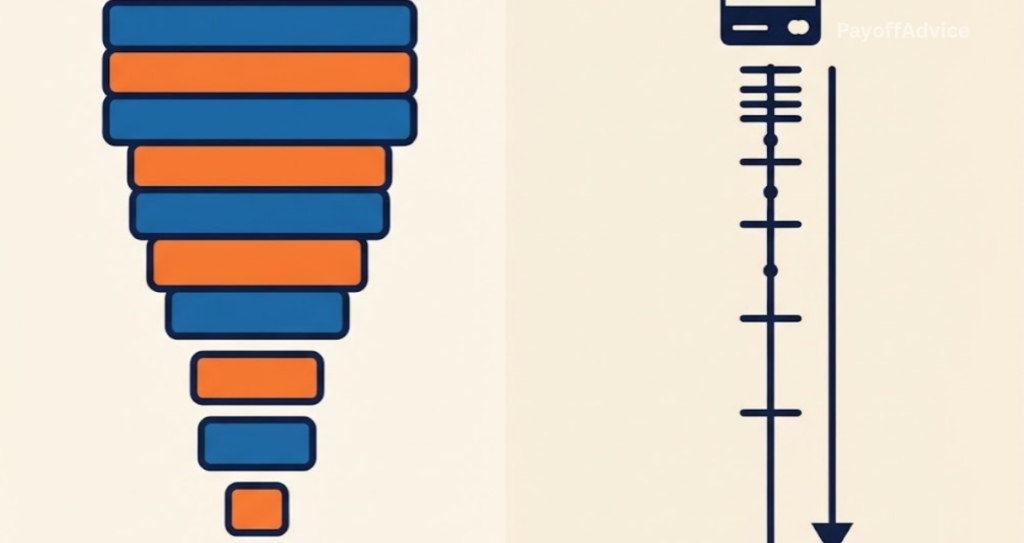
- Method effectiveness: a LendingTree analysis found avalanche and snowball produced payoff totals within about $29 of each other on a matched hypothetical debt load, both finishing in 57 months, though savings gaps widen on larger, more varied balances.
These numbers make one thing clear: the interest rate environment isn’t forgiving, but a deliberate plan closes the gap fast. Whichever combination of the ten strategies above you use, the goal is the same — stop paying the bank’s timeline and start paying yours.
Frequently Asked Questions
What is the fastest way to pay off credit card debt?
The fastest way to pay off credit card debt fast is to combine the debt avalanche or snowball method with extra payments above the minimum, a 0% balance transfer if you qualify, and a spending freeze on the card while you pay it down. Combining tactics beats relying on any single one.
Is the debt avalanche or debt snowball method better?
Avalanche saves more in interest because it targets your highest-APR balance first. Snowball, which targets your smallest balance first, has been shown in a Kellogg School of Management study to help more people finish paying off all their debt because of the motivation from early wins. The best method is the one you’ll stick with.
How much extra should I pay toward credit card debt each month?
Even an extra $50-$100 per month above the minimum meaningfully shortens a payoff timeline on a typical $5,000-$6,700 balance. The more consistent the extra payment, the faster you outrun the 22%+ average APR.
Will a balance transfer card actually help me pay off debt faster?
Yes, if you can pay off the balance before the 0% introductory period ends, typically 12-15 months. Every payment goes to principal instead of interest during that window, though most cards charge a 3-5% transfer fee upfront.
Should I close my credit card after paying it off?
Not immediately. Closing a card can shorten your credit history and raise your credit utilization ratio, which may lower your credit score. Many people keep the card open with a $0 balance or a small recurring charge that’s paid in full each month.
How does a personal loan help with credit card debt?
A personal loan consolidates multiple card balances into one fixed payment at a lower, fixed interest rate than most cards’ 20%+ APR, which makes the payoff date predictable and easier to budget for.
What is the average credit card debt in 2026?
The average American carried $6,715 in credit card debt as of December 2025, according to TransUnion, while total U.S. credit card balances reached $1.252 trillion in the first quarter of 2026, per the Federal Reserve Bank of New York.
How long does it take to pay off credit card debt with minimum payments only?
A $5,000 balance at a 22% APR paid at the minimum (roughly 2% of the balance) takes about 9 years and 7 months to clear, and costs around $6,520 in interest — more than the original balance.
Can I negotiate a lower interest rate with my credit card company?
Yes. Calling your issuer and asking for a lower APR, especially if you have a history of on-time payments, works more often than most people expect and costs nothing to try.
Does building an emergency fund slow down debt payoff?
A small starter fund of $500-$1,000 typically speeds up debt payoff overall, because it prevents the next unexpected expense from going back onto the card and undoing your progress.