Debt Management & Credit
Should You Pay Off Debt or Invest First in 2026? A Decision Guide
Should you pay off debt or invest first? See the interest-rate math, 2026 Federal Reserve data, and a simple framework to make the right call.


If you have spare cash this month, deciding whether to pay off debt or invest first is one of the most common — and most consequential — personal finance dilemmas. Get it wrong and you either bleed money to double-digit interest charges or leave years of compound growth on the table. The right call almost always comes down to one comparison: the interest rate on your debt versus the return you can realistically expect from investing.
The Real Math: Debt Interest vs. Investment Returns
The average credit card carried an APR of roughly 21% to 24% in 2026, depending on the account and issuer, according to Federal Reserve consumer credit data. Meanwhile, the S&P 500 has returned about 10% annually on average since 1957 (10.59% annualized over the last 100 years), including the inevitable down years. When your guaranteed “cost” of carrying debt is more than double your realistic long-term investment return, paying down that debt is the higher-certainty move.
This isn’t a hypothetical problem. Total U.S. credit card balances hit $1.252 trillion in the first quarter of 2026, up 5.9% year-over-year, according to the Federal Reserve Bank of New York’s Household Debt and Credit Report. Total household debt across mortgages, autos, and credit cards climbed to $18.8 trillion in the same quarter. More people are carrying a balance from month to month than at almost any point on record, which makes this decision more urgent than ever.
When Paying Off Debt Wins
High-interest debt is the clearest case. Credit cards, retail store cards, and most personal loans above 15% to 20% APR cost more than almost any diversified investment reliably earns. Paying off a card charging 22% interest is the equivalent of a guaranteed 22% return — no index fund can promise that. If you’re carrying this kind of balance, our guide on how to pay off credit card debt faster walks through the fastest payoff strategies, including which method saves the most in interest.
Paying off debt first also removes risk. Investment returns fluctuate year to year; a debt payoff is a locked-in, tax-free “return” the moment the balance hits zero. For anyone feeling squeezed by minimum payments, that certainty carries real psychological value on top of the math.
When Investing First Makes Sense
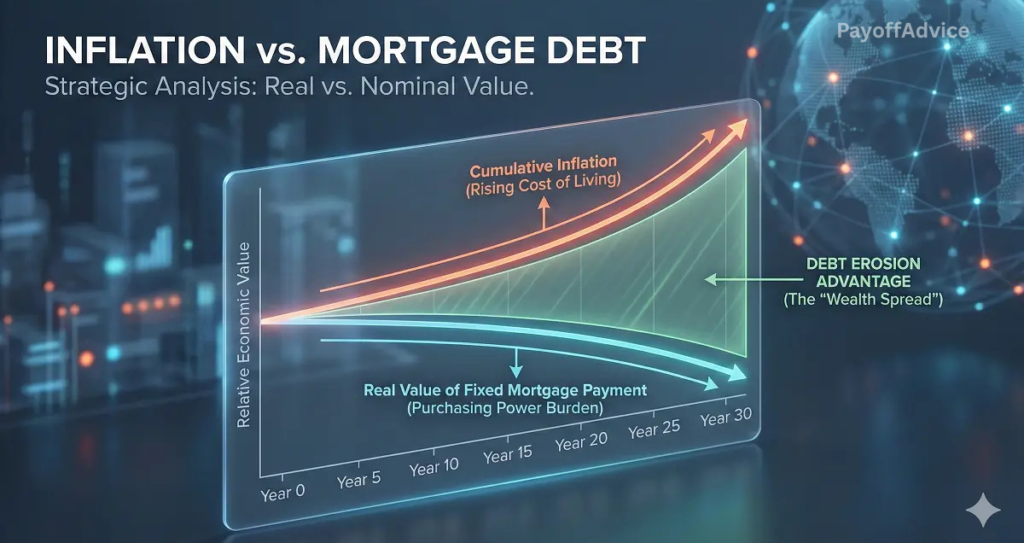
The calculation flips for low-interest debt. Mortgages (averaging around 6% to 7% in 2026) and federal student loans (typically 5% to 7%) rarely cost enough to outweigh long-term market growth. In these cases, investing — especially inside tax-advantaged accounts — usually wins over accelerated payoff.
The single biggest exception that should almost always come first: an employer 401(k) match. If your employer matches contributions, that’s an instant 50% to 100% return before the money is even invested — no market return can compete with free money. If you’re unsure which retirement account to prioritize once you’re contributing enough to capture the match, see our comparison of 401(k) vs. Roth IRA: which account to fund first.
The Middle Path: Do Both at Once
Most people don’t need to pick one extreme. A workable order that fits nearly every income level looks like this: keep a small starter emergency fund of $500 to $1,000, pay at least the minimum on every debt to avoid fees and credit damage, capture any employer 401(k) match in full, then throw every extra dollar at your highest-interest debt until it’s gone. Once high-interest debt is cleared, redirect that same payment amount into retirement and brokerage accounts.

This blended approach avoids the two most common regrets: investing while a 24% APR balance quietly grows, or missing years of an employer match while aggressively paying down a 6% mortgage.
A Simple Decision Framework by Interest Rate
- Above 8% APR (credit cards, most personal loans, payday loans): pay off debt first — the guaranteed savings beat expected market returns.
- 5% to 8% APR (private student loans, some auto loans): split the difference — pay extra toward the debt while still investing enough to get any employer match.
- Below 5% APR (many mortgages, federal student loans, subsidized loans): invest first — long-term market growth has historically outpaced these rates.
Common Mistakes to Avoid
- Investing aggressively while carrying credit card debt above 20% APR — the math almost never works in your favor.
- Skipping the 401(k) match window entirely while focused on debt payoff, even by one paycheck cycle.
- Not keeping any cash buffer, which forces new debt the moment an unexpected expense hits.
- Treating every debt the same, instead of ranking by actual interest rate.
Bottom Line
There’s no single universal answer to whether you should pay off debt or invest first — but there is a reliable formula. Compare your after-tax interest rate to a realistic long-term investment return (historically around 7% to 10% for a diversified stock portfolio). Above that line, pay off debt first. Below it, invest first, after capturing any employer match. When rates sit close to that line, split your extra cash between both goals so you’re never leaving free money — or guaranteed savings — on the table.
Frequently Asked Questions
Should I pay off debt or invest first?
Compare your debt’s interest rate to your expected investment return. If your debt charges more than about 7% to 8% APR, pay it off first; if it charges less, investing — especially with an employer match — usually wins long term.
What interest rate is considered “high” for debt payoff priority?
Most planners use 7% to 8% APR as the cutoff, since that roughly matches long-term stock market returns. Credit cards, averaging 21% to 24% APR in 2026, are well above that line.
Should I pay off credit cards before contributing to a 401(k)?
Contribute enough to get any employer match first, since that’s an immediate 50%-100% return. Beyond the match, prioritize paying off credit card debt before adding extra retirement contributions.
Is it smart to invest while still in debt?
It depends on the debt’s interest rate. Investing while carrying low-rate debt like a mortgage is generally fine; investing while carrying high-rate credit card debt usually costs you more in interest than you’ll earn.
What if my employer offers a 401(k) match?
Capture the full match before accelerating debt payoff, even if you’re carrying credit card debt. The match is a guaranteed return no debt payoff can beat, so skipping it is rarely worth it.
Should I pay off my mortgage before investing?
Usually not. Mortgage rates around 6% to 7% are close to or below historical stock market returns, so most homeowners come out ahead investing extra cash instead of prepaying the mortgage.
How much should I keep in an emergency fund before investing?
Start with $500 to $1,000 as a buffer before aggressively paying off debt or investing, then build toward three to six months of expenses once high-interest debt is cleared.
What’s the average credit card interest rate in 2026?
Average credit card APRs have ranged from about 21% to 24% through 2026, depending on the data source and account type, according to Federal Reserve and industry reporting.
Does the stock market always outperform debt interest rates?
No. The S&P 500 averages about 10% annually over long periods, but any single year can be negative. That volatility is exactly why guaranteed high-interest debt payoff is treated as the safer priority.
Can I do both — pay off debt and invest — at the same time?
Yes, and for most people it’s the practical answer: cover minimum payments, capture any employer match, then split remaining cash between extra debt payments and investing based on the interest-rate framework above.