Investment and Assets
Index Funds Explained for Complete Beginners
Index funds are the simplest, lowest-cost way most people build long-term wealth. Here is a complete beginner’s explanation of how they work, backed by current market data.


Index funds are one of the simplest and most widely recommended ways for beginners to invest, and current data shows why: roughly $20 trillion is now indexed or benchmarked to the S&P 500 alone. Rather than trying to pick winning stocks, an index fund simply owns all, or a representative sample, of the companies in a market index, giving you broad diversification in a single investment.
Here is a complete beginner’s explanation of how index funds work, grounded in current market data.
What Is an Index Fund?
An index fund is a mutual fund or ETF designed to track the performance of a specific market index, such as the S&P 500, rather than trying to beat it through active stock picking. If the fund manager does their job well, the fund’s returns closely mirror the index it tracks, minus a small fee called the expense ratio.
What Is the S&P 500 and Why It Matters
The S&P 500 tracks 500 of the largest publicly traded U.S. companies and is the most widely used benchmark for the overall stock market. Since its inception in 1957, the S&P 500 has delivered an average annual return of approximately 10 to 10.5 percent, including reinvested dividends, though any single year can vary dramatically from that average.
Why Average Returns Do Not Tell the Whole Story
Over the 50 years from 1975 to 2024, the S&P 500 produced a median annual return of 13.1 percent with a standard deviation of 16 percent, meaning only about 68 percent of years fell between a 5.4 percent loss and a 26.6 percent gain. In practice, this means the market rarely delivers exactly its long-term average in any given year, and investors need to expect meaningful year-to-year swings even while holding a broadly diversified index fund.
Why Index Funds Cost So Little
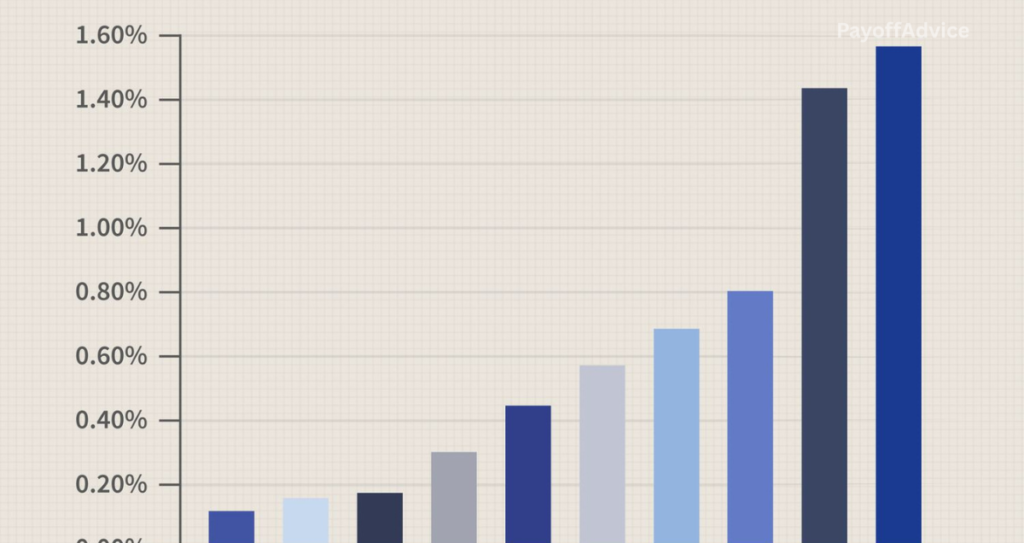
Because index funds simply track a benchmark rather than paying analysts to pick stocks, their expense ratios are dramatically lower than actively managed funds. Some of the largest S&P 500 index funds now charge as little as 0.03 percent annually, compared to 0.5 to 1.5 percent for many actively managed funds. Our guide on ETF vs mutual funds breaks down how these cost differences compound significantly over long investing horizons.
Understanding Market Concentration Risk
The S&P 500 is weighted by market capitalization, meaning larger companies have a greater influence on performance. As of early 2026, the technology sector alone accounts for nearly a third of the index, and the top 10 stocks represent approximately 37 percent of the total index weight. This means an S&P 500 index fund is less diversified than many beginners assume, since its performance is increasingly tied to a small handful of mega-cap technology companies.
Comparing Index Funds to Other Asset Classes
Over the past 20 years, the S&P 500 has outperformed most other major asset classes, with U.S. aggregate bonds returning around 3.5 percent annualized, real estate investment trusts returning about 7.8 percent, and gold returning roughly 8.1 percent over the same period. This historical outperformance is a key reason index funds tracking U.S. stocks remain the core holding in most long-term investment portfolios.
How to Buy Your First Index Fund
Most major brokerages allow you to buy index funds through either a mutual fund or an ETF structure tracking the same index, often with no minimum investment and no commission. Choosing between the ETF or mutual fund version generally comes down to your account type and whether you are investing a precise dollar amount, as covered in our guide on starting to invest with less than $100.
Why Consistency Matters More Than Timing
The S&P 500 experiences a meaningful sell-off of 5 percent or more roughly once a year on average, according to market data, with declines of 10 percent or greater occurring roughly every two and a half years. Rather than trying to avoid these normal dips, investors who stay consistently invested through volatility have historically captured the long-term average return, while those who panic-sell during downturns tend to underperform the index itself.
Should Beginners Diversify Beyond the S&P 500?
Given the concentration in mega-cap technology stocks, some investors choose to complement an S&P 500 index fund with international index funds, small-cap funds, or equal-weight index funds that reduce reliance on the largest companies. This is not necessary for every beginner, but it is worth understanding as your portfolio grows and your risk tolerance becomes clearer.
Final Thoughts
Index funds remain one of the simplest, lowest-cost ways to build long-term wealth, backed by decades of consistent outperformance relative to most other major asset classes. Understanding both the historical average return and the very real short-term volatility around that average helps set realistic expectations, so a normal market dip does not derail a sound long-term investing plan.
Frequently Asked Questions
1. What is an index fund?
An index fund is a mutual fund or ETF designed to track a specific market index, such as the S&P 500, rather than trying to beat it through active stock picking.
2. What has the S&P 500’s average annual return been historically?
The S&P 500 has averaged roughly 10 to 10.5 percent annually since 1957, including reinvested dividends.
3. Why are index fund expense ratios so low?
Since index funds simply track a benchmark rather than paying analysts to actively pick stocks, they require far less active management, keeping costs low, often around 0.03 to 0.14 percent for major index funds.
4. Is the S&P 500 fully diversified?
Not as much as many assume, since it is weighted by market capitalization and the top 10 stocks represent roughly 37 percent of the total index weight as of early 2026.
5. How often does the market experience declines?
The S&P 500 experiences a sell-off of 5 percent or more roughly once a year on average, with 10 percent-plus declines occurring roughly every two and a half years.
6. Should I buy an index fund as an ETF or a mutual fund?
Both track the same index, so the choice generally depends on your account type and whether you are investing a precise dollar amount each time.
7. How does the S&P 500 compare to bonds and real estate?
Over the past 20 years, the S&P 500 has outperformed U.S. aggregate bonds and REITs, though this does not guarantee the same pattern will continue going forward.
8. Do I need to pick individual stocks to build wealth?
No, index funds provide broad diversification without needing to pick individual winning stocks, which is why they remain popular among long-term investors.
9. What is an equal-weight index fund?
It is a fund that weights all companies in an index equally rather than by market capitalization, reducing reliance on the largest mega-cap companies.
10. Is it risky to invest in an index fund at an all-time market high?
Markets have historically recovered from downturns over long time horizons, and staying invested consistently has generally outperformed trying to time entry points precisely.